What “Agentic Marketing” Means for a $5M Business
Agentic marketing for a $5 million business: capture leads, qualify, follow up, and measure under human oversight. Start with one bottleneck. Scale what works.
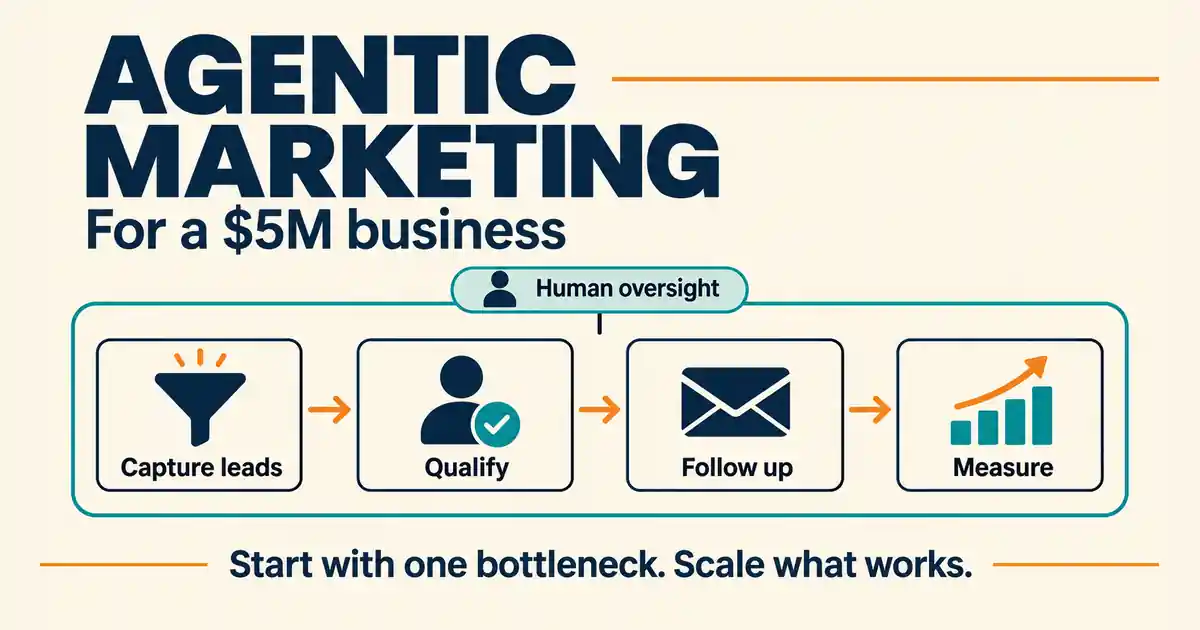
If you run a $5 million business, you don’t need another technology trend to manage. You need more qualified opportunities, better conversion, and a marketing team that can grow without adding cost at the same rate.
That’s the practical promise of agentic marketing: AI systems that don’t just produce content or answer questions, but take bounded actions toward a marketing goal.
The key word is bounded.
From generating content to getting work done
Most businesses use AI as an assistant: write an email, summarize a report, suggest a headline. A person still moves the work through every step.
An agentic system can execute a connected workflow. For example, it might:
- Identify inbound leads that haven’t received a response.
- Check their company information against your ideal customer profile.
- Prepare a relevant follow-up using approved messaging.
- Send it within defined rules or route it for approval.
- Update your CRM and flag exceptions for a salesperson.
Traditional automation follows a predetermined path. An AI agent can interpret context and choose among permitted next steps.
That flexibility is useful, but it also creates new ways to make mistakes.
The best starting point is a revenue bottleneck
As a fractional CTO/CMO, I look at agentic marketing through two lenses: Will it improve commercial performance? And can we operate it reliably?
For a $5 million business, the strongest first use case is usually a narrow, repetitive process where delays or inconsistency already cost money.
Think lead qualification, follow-up coordination, or campaign reporting, not handing your entire marketing strategy to an autonomous system.
Choose a workflow with:
- A clear owner.
- Reliable source data.
- A measurable outcome.
- Limited consequences if something goes wrong.
If your CRM is inconsistent and nobody agrees on what makes a qualified lead, fix that first. An agent won’t resolve operational confusion; it may simply act on it faster.
Give it boundaries before giving it access
The CMO question is, “Does this strengthen the customer experience?” The CTO question is, “What can this system access, change, or send?”
Both matter.
An agent drafting a campaign brief needs different controls from one contacting customers or changing advertising budgets. Start with minimum permissions, approved claims, activity logs, and human review for consequential actions.
You should be able to explain what the agent is allowed to do, and stop it quickly when necessary.
Autonomy should expand only as performance earns trust.
Run a pilot, not a transformation program
Start with one workflow and establish a baseline. Then run a time-limited pilot.
Measure the outcome that matters: response time, qualified meetings, conversion, or staff time recovered. Track errors and review effort too. More activity is not automatically more value.
The business case should include software, integration, maintenance, and oversight, not just the subscription price.
For a $5 million business, agentic marketing isn’t about replacing the marketing department. It’s about removing specific execution constraints so your people can spend more time on positioning, customer insight, and growth decisions.
Start with the bottleneck, not the technology. Give the system a narrow job, measure the result, and expand only when the economics work.
Where could agentic marketing help your business?
Book a 30-minute discovery call. We’ll discuss your biggest marketing bottleneck and whether an AI agent, simpler automation, or a process fix is the right next step.